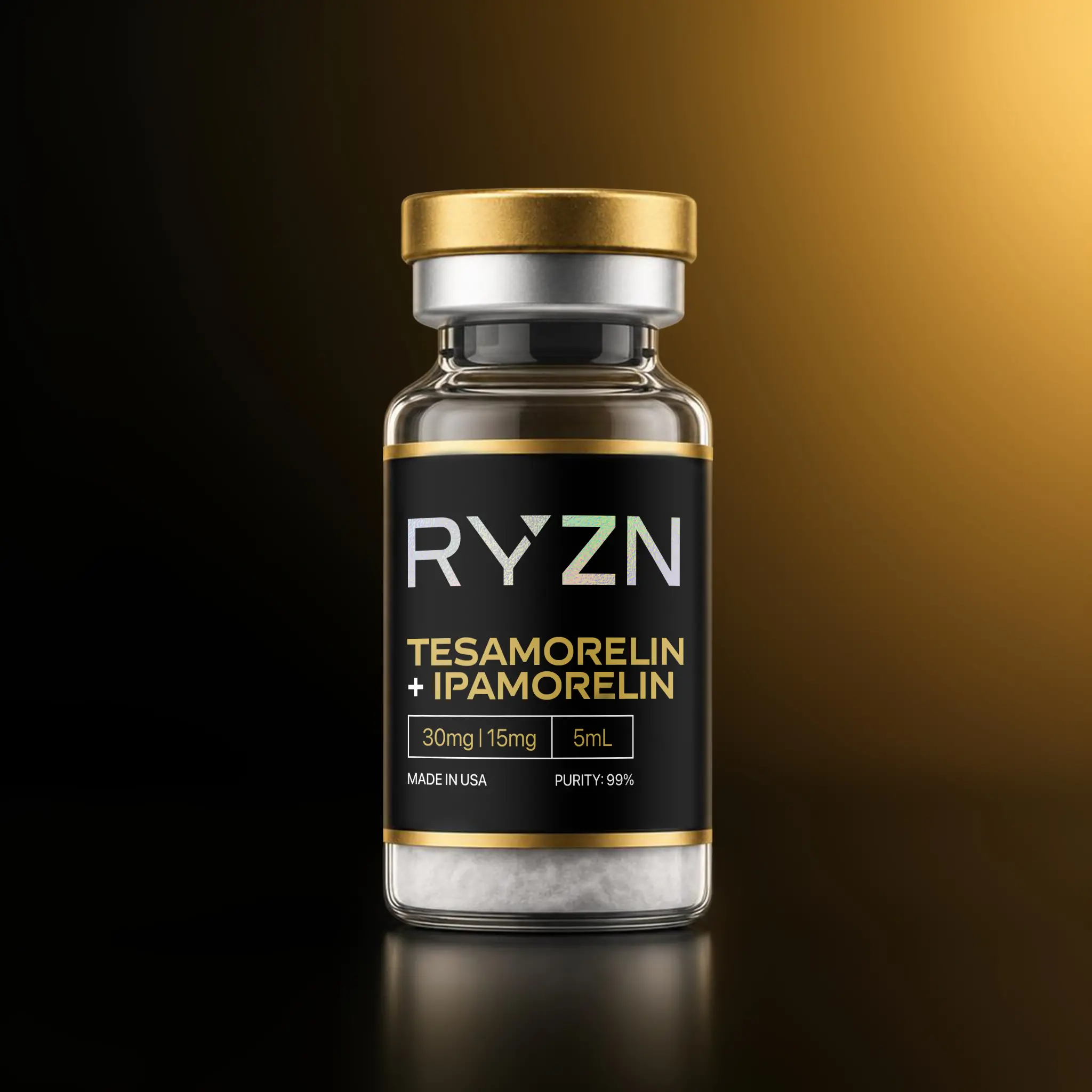
Tesamorelin 30mg + Ipamorelin 15mg
Tesamorelin + Ipamorelin combines two peptides that stimulate growth hormone (GH) signaling through complementary pathways. Tesamorelin is a synthetic GHRH analog that promotes pituitary GH release, while Ipamorelin is a selective ghrelin receptor agonist that stimulates GH secretion through the GHS-R1a receptor.
Research on this combination is centered on pulsatile GH release, IGF-1 signaling, body-composition pathways, metabolic function, recovery, and endocrine physiology.
Wholesale access
Apply for Wholesale AccessPricing is quoted per order under our at-will wholesale model — based on the products and volumes you need. Apply for partner access to request a quote.
Tesamorelin + Ipamorelin combines two growth hormone secretagogues that act through different but complementary signaling pathways.
Tesamorelin is a synthetic 44-amino-acid analog of growth hormone-releasing hormone (GHRH), while Ipamorelin is a pentapeptide ghrelin mimetic that activates the growth hormone secretagogue receptor, GHS-R1a.
Together, these peptides are studied for their effects on pulsatile growth hormone release, IGF-1 signaling, body composition, metabolic physiology, and recovery-related pathways.
How Tesamorelin Works
Tesamorelin acts as a GHRH receptor agonist at the pituitary gland.
By activating GHRH receptors, Tesamorelin stimulates the pituitary to release endogenous growth hormone. This increase in GH signaling can subsequently influence downstream insulin-like growth factor 1 (IGF-1) production and other growth hormone-dependent physiological processes.
Research involving Tesamorelin has focused extensively on growth hormone signaling, visceral adipose tissue, body composition, and metabolic function.
How Ipamorelin Works
Ipamorelin activates the GHS-R1a receptor, also known as the ghrelin or growth hormone secretagogue receptor.
This pathway stimulates endogenous GH release through a mechanism distinct from GHRH receptor activation.
Ipamorelin has attracted research interest because of its relatively selective effect on growth hormone secretion compared with earlier growth hormone-releasing peptides. Published research has examined its ability to stimulate GH with comparatively limited effects on cortisol, prolactin, and ACTH.
Dual-Pathway Growth Hormone Signaling
Combining a GHRH analog with a ghrelin receptor agonist allows researchers to investigate two complementary mechanisms of growth hormone release simultaneously.
Tesamorelin stimulates the GHRH pathway, while Ipamorelin stimulates the GHS-R1a pathway.
Research on combined GHRH and growth hormone secretagogue signaling suggests that activating both pathways can produce a greater GH response than stimulating either pathway independently.
Pulsatile Growth Hormone Research
Growth hormone is naturally secreted in pulses rather than at a constant rate.
Tesamorelin and Ipamorelin are both studied for their ability to stimulate endogenous GH secretion while preserving aspects of the body’s natural pulsatile signaling system.
Human pharmacokinetic research involving Ipamorelin has demonstrated a relatively rapid GH response following administration, making it useful for studying the timing and dynamics of growth hormone secretion.
Body Composition Research
Tesamorelin has been extensively investigated for its effects on body composition and adipose tissue.
Clinical research has demonstrated reductions in visceral adipose tissue and trunk fat in specific studied populations. These findings have contributed to broader interest in the relationship between GH/IGF-1 signaling, fat distribution, and metabolic physiology.
The Tesamorelin + Ipamorelin combination is therefore of particular interest in research examining growth hormone signaling and body-composition pathways.
IGF-1 and Metabolic Signaling
Growth hormone stimulates the production of insulin-like growth factor 1 (IGF-1), an important mediator of many downstream GH-related effects.
Research involving Tesamorelin and other GH secretagogues frequently evaluates IGF-1 alongside markers of metabolism, body composition, tissue remodeling, and endocrine function.
Changes in these pathways can vary considerably depending on study population, exposure, nutritional status, and other physiological variables.
Recovery and Tissue Research
Growth hormone and IGF-1 participate in numerous processes associated with protein metabolism, connective tissue, cellular repair, and adaptation.
For this reason, Tesamorelin and Ipamorelin are also studied in research involving recovery, tissue remodeling, and physiological adaptation.
These areas remain closely linked to the broader investigation of endogenous GH and IGF-1 signaling.
Hormonal Selectivity
A notable characteristic of Ipamorelin is its selectivity for growth hormone release.
Compared with some earlier growth hormone-releasing peptides, research suggests that Ipamorelin has comparatively little influence on cortisol, prolactin, or ACTH at studied exposures.
This selectivity makes it useful in research designed to examine GH signaling while reducing interference from other pituitary hormone pathways.
Research and Tolerability
Tesamorelin and Ipamorelin have each been evaluated in clinical or experimental research.
Reported adverse effects associated with Tesamorelin have included injection-site reactions, joint discomfort, and peripheral edema. Research involving Ipamorelin has generally reported favorable tolerability, although transient effects such as flushing or headache have been observed.
Research findings and tolerability data depend on the population, formulation, exposure level, and study design.
Key Research Characteristics
- Combines a GHRH analog with a GHS-R1a agonist
- Stimulates endogenous growth hormone release
- Investigated for enhanced pulsatile GH signaling
- Supports research into downstream IGF-1 activity
- Studied in body-composition and metabolic research
- Tesamorelin has been investigated for effects on visceral adipose tissue
- Ipamorelin is studied for its GH selectivity
- Relevant to research involving recovery and tissue remodeling
- Provides two complementary pathways for studying the GH/IGF-1 axis
The Tesamorelin + Ipamorelin blend provides researchers with a dual-pathway approach to investigating endogenous growth hormone signaling. By combining GHRH receptor activation with selective GHS-R1a stimulation, this blend is particularly relevant to research involving pulsatile GH release, IGF-1 signaling, body composition, metabolic physiology, and recovery-related pathways.
| Strength | 45mg |
|---|---|
| Featured | |
| Goal | |
| Count/Size | 5mL Vial |